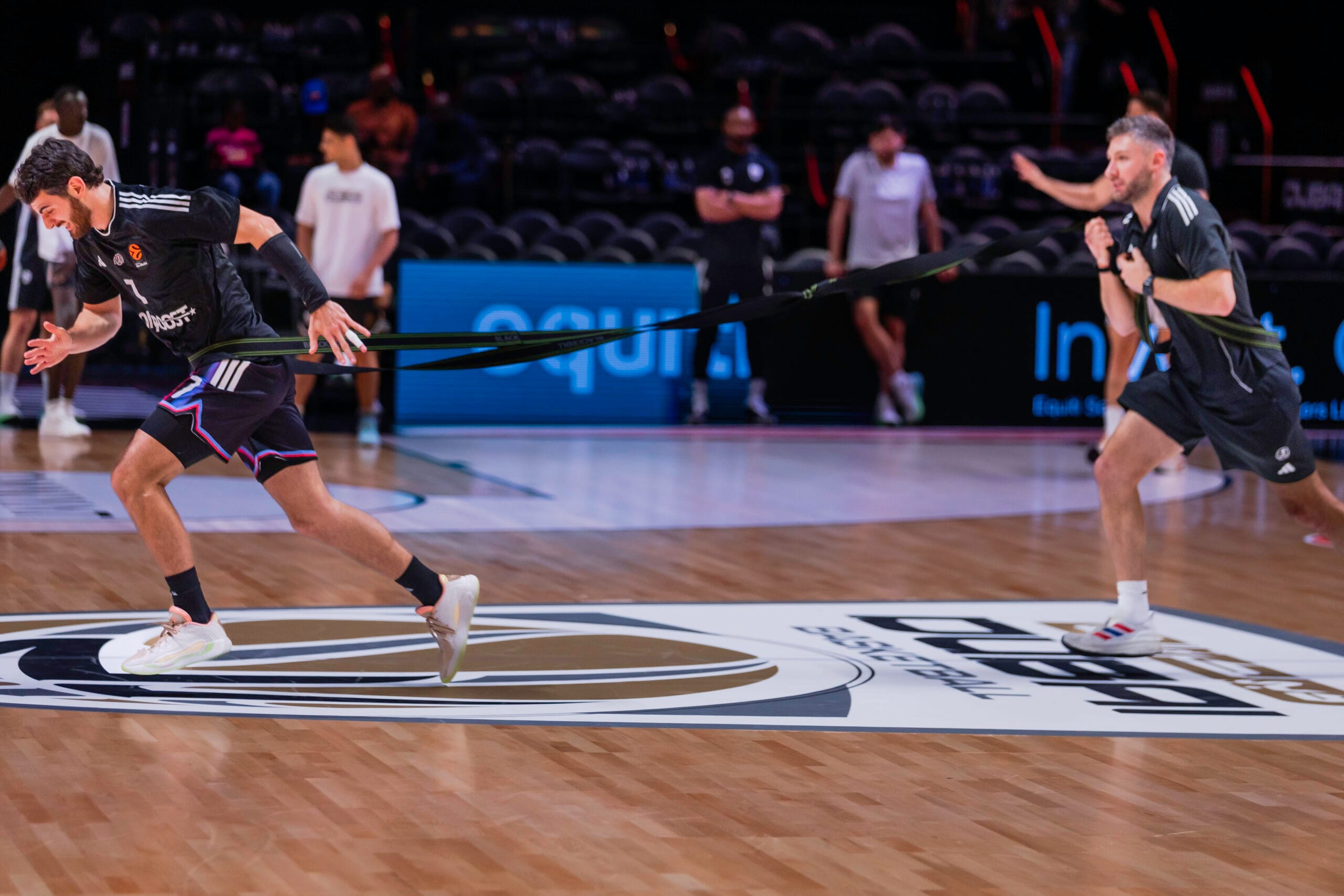
Authors: Francesco Cuzzolin, Jaime Sampaio, Julio Calleja-González, Igor Jukic, Baris Kocaoglu, Mar Rovira, Antonio Santo.
GAME AFTER GAME, SEASON AFTER SEASON: THE SCIENCE BEHIND PLAYER LOAD OWNERSHIP
In EuroLeague basketball, every game counts – literally. In the world’s most demanding league, elite performance is built not only on skill and competitive drive, but also on the precision with which players manage the physical, neurological, and psychological stress accumulated through practices, games, and travel. Load management is no longer only a buzzword. For those who want longevity, consistency, and real impact, it has become a science, a discipline, and above all a personal mission, not just a staff responsibility. This is what we call Player Load Ownership.
WHY PLAYER LOAD OWNERSHIP SHOULD MATTER TO YOU
As an elite player, your job goes far beyond executing a game plan. You are the only one who truly feels every practice, every travel day, and every lifting session. External load (measured by sensors and LPS systems) and internal load (from personal RPE, heart rate, wellness scores, and integrative variables such as those from saliva or blood testing) represent the two sides of your daily reality. When these data points are tracked and understood, they become your personal map, showing you when to push, when to recover, and when to adjust.
EuroLeague data confirms that load is not distributed evenly: starters accumulate significantly higher workloads than rotation or bench players, especially during multi-game weeks or compressed schedules. Salazar et al.(2025) showed that starters face the steepest load spikes when games cluster later in the week (Friday–Sunday). Rotation players accumulate moderate load; bench players remain lower. When coaches adapt training volume and intensity to game rhythm, reducing volume or shifting toward mobility and recovery on “heavy weeks”, players stay fresher, more resilient, and more productive.
But as you can imagine, this differentiation is not always easy for coaching staffs. There is no single solution that fits every player, every role, or every week.
THE DANGER OF IGNORING YOUR LOAD MANAGEMENT
Ignoring your load management numbers comes with risk: chronic fatigue, under-recovery, mental burnout, and a higher likelihood of overuse injuries, especially when game density and travel outpace recovery capacity. Another risk is the opposite scenario: travelling for weeks with mostly individual work and then suddenly stepping onto the court with minimal team practice. That jump exposes players to extremely intense efforts without adequate, specific preparation, potentially hurting both performance and injury protection.
Published research from the ACB (Caparrós et al., 2018) and the EuroLeague data shows that peak external-load weeks, particularly three-game stretches, correlate with increased injury rates and decreased in-game efficiency for players who do not manage their load proactively.
Conversely, players who understand and communicate/share their numbers and data with team staff members can adjust days off, fine-tune court work, and time extra conditioning to their advantage, not just for “injury prevention,” but to maximize readiness and impact.
OWNERSHIP: THE PLAYER’S COMPETITIVE EDGE
Being ready every game and every season means more than just being present, it means being effective, avoiding dips, and performing at your best in high-pressure moments. Science consistently shows that when athletes own their recovery, report how they feel, and actively review and discuss their data, their performance becomes more stable, and their peaks appear at the right time. Wellness and self-reporting aren’t forms; they are tools for your health, availability, and career longevity.
FROM SCIENCE TO PRACTICE: YOUR PERSONAL PLAYER LOAD MANAGEMENT STRATEGY
1. Track Both External and Internal Load
External load comes through technology (Player Load, LPS, accelerometers), while internal load includes RPE, wellness scores, HR monitoring, and recovery indicators such as HRV and sleep quality. Check these numbers daily, especially after heavy travel or back-to-back games and try to optimize your training and recovery procedures.
2. Adjust Recovery as Precisely as Training
If your load spikes, during triple-game weeks or long travel stretches, prioritize recovery: extra sleep, active recovery sessions, physiotherapy, and low-impact technical work. Rest is not an absence of training; rest is training for the next performance.
3. Discuss Your Numbers
Sharing trends and scores with performance, medical, and coaching staff matters. Many clubs customize minutes, practice plans, and individual sessions based on data, not outdated traditional beliefs like “we’ve always done it this way.” Respect for roles is essential, but your feedback is part of the performance equation. Research shows that teams who monitor all players, not only starters, maintain higher availability, consistency, and resilience deep into the season.
4. Self-Reporting = Injury Prevention
Data from professional basketball shows that not enough exposure to external load also increases injury risk. Being “ready every game” means exposing your body to the right micro-stress for adaptation, while avoiding chronic monotony or overload. Weekly variability, when planned and reviewed, is protective, as confirmed by performance, clinical, and wellness protocols.
ARE YOU READY EVERY GAME?
Elite performance starts and ends with YOU. Load management is a career-defining tool not just for surviving the EuroLeague grind, but for being at your best when it matters most. For this to happen, consider the following:
- Master your numbers.
- Review your data.
- Own your process.
- Communicate with your performance staff and work together to optimize the system with you, around you and for you – also to the benefit of the entire team.
The performance in your next game and in your next season(s) will have plenty of benefits, depending on how well you execute the Science of Player Load Ownership!
References
- Salazar N, et al. Does the Weekly Distribution of Games and Competition Density Affect Training Load in Elite Male Basketball Players Based on their Playing Role? Int Journal of Strength and Conditioning, Vol 5 N.1, 2025.
- Caparros T, et al. Low External Workloads Are Related to Higher Injury Risk in Professional Male Basketball Games, J Sports Sci Med, May 14;17(2):289–297, 2018.
- Wellm D, et al. Differences in Player Load of Professional Basketball Players. Journal IUSCA, Vol.3 No.1, 2023.
- Chan CC, et al. The Relationship between Training Load and Injury Risk in Basketball.
Healthcare (Basel) 2024 Sep 13;12(18):1829, 2024. - Burger J, et al. Athlete Monitoring Systems in Elite Men’s Basketball, Transl Sports Medicine, Vol 2024, 6326566, 2024.